What Are Microlink Hair Extensions? How I-Tips WorkUpdated 3 months ago
Microlink hair extensions are a professional strand-by-strand method that uses small cylinder beads to attach individual extension strands to sections of your natural hair. They are also commonly searched for as microbead hair extensions.
Unlike sew-ins, tape-ins, or keratin bonds, an I-Tip microlink installation does not require braids, adhesive, or heat to secure the extensions. The placement can be customized around your natural density, haircut, texture, and styling goals.
Quick answer:
I-Tips are the individual hair extension strands. A microlink is the installation method used to attach those strands with small beads. The terms are often used together, but they describe two different parts of the service.
How Do Microlink Hair Extensions Work?
During an I-Tip microlink installation, a trained stylist passes a small section of natural hair through a microbead, positions the I-Tip strand, and closes the bead with professional extension pliers. The bead holds the natural hair and extension strand together without glue or heat.
Each strand is placed individually, allowing the stylist to control the amount of extension hair, the spacing between strands, and where additional length or fullness is needed.

A professional applying a microbead and I-Tip during a strand-by-strand installation
What Do Microlink Extensions Look Like Once Installed?
A well-planned microlink installation can add length, fullness, shape, and natural movement while allowing the client’s own hair to remain part of the finished look. Results depend on texture matching, extension quantity, placement, blending, and professional styling.
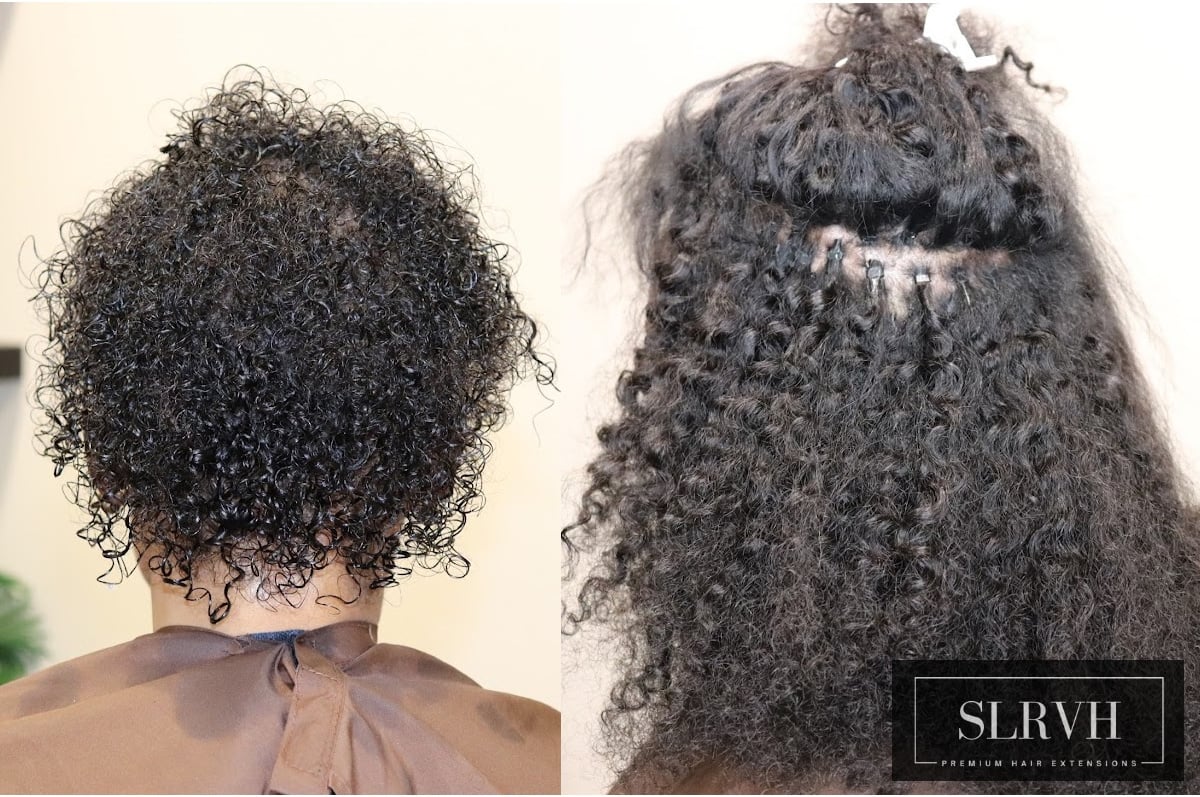
Real Lao Curly I-Tip transformation on naturally curly hair
See the Full Curly Microlink Transformation
Watch the Installation and Finished Result
This professional transformation shows how individual I-Tip strands are placed and blended into naturally curly hair.
Why Do Customers Choose Microlinks?
- No glue or heat: I-Tip strands are secured with beads rather than adhesive or fusion heat.
- Strand-by-strand movement: Individual placement allows the extensions to move more naturally with the client’s own hair.
- Scalp access: The installation leaves the scalp accessible for cleansing and regular care.
- Customized placement: A stylist can adjust strand quantity and placement according to the client’s density, haircut, and styling preferences.
- Flexible styling: Depending on the placement plan, microlinks may support different parts, ponytails, curls, and straight styles.
- Reusable extension hair: I-Tip hair may be reused when professionally removed and properly maintained.
What Should You Know Before Getting Microlinks?
Microlinks are a professional, semi-permanent extension service. They require more planning and upkeep than temporary extensions.
- A stylist should evaluate your natural density, length, condition, and desired result before installation.
- Your texture and extension quantity should be selected before the appointment.
- The number and weight of the strands must be appropriate for the natural hair supporting them.
- Professional maintenance is required as the natural hair grows and the beads move farther from the scalp.
- The installation should be professionally removed rather than pulled, cut, or taken out at home.
- At-home cleansing, drying, and detangling habits will affect the comfort and longevity of the installation.
Professional recommendation:
For the best results, your natural hair should be at least four inches long before receiving I-Tip extensions.
Who May Be a Good Candidate for Microlinks?
Microlinks may be considered for customers who have healthy natural hair, enough density to support the added strands, and sufficient length to cover and blend with the attachment points.
Fine hair is not automatically unsuitable for microlinks. However, fine hair and actively thinning, severely weakened, or significantly broken hair should not be treated as the same situation. An experienced stylist should confirm whether the natural hair can support the installation.
Your installation should feel secure, not painful.
Ongoing pulling, unusual tenderness, visible irritation, or excessive discomfort should be discussed with your stylist promptly.
Traditional or Seamless I-Tips: Which Should You Choose?
SL Raw Virgin Hair offers two I-Tip formats for professional microlink installations. The best option depends on your natural density, preferred texture, desired fullness, and finished style.
Traditional I-Tips
Traditional I-Tips hold more hair per strand and are suited to fuller installations, textured blending, natural movement, and customized strand placement.
Seamless I-Tips
Seamless I-Tips have a flatter, lighter attachment point for lower-bulk blending on healthy fine-to-medium-density hair, sleek styles, and customized color matching.
How Many I-Tip Packs Will You Need?
Your quantity will depend on whether you choose Traditional or Seamless I-Tips, along with your natural density, head size, desired length, and preferred fullness. Seamless I-Tips generally require more individual strands because of their flatter, lighter design.
Where Should You Go Next?
Choose the next step that best matches where you are in your hair-extension journey.
New to hair extensions?
Learn about I-Tips, K-Tips, wefts, wigs, textures, quantity, care, and maintenance before choosing a method. Start with Hair Extensions 101
Ready to compare your shopping options?
Browse the available extension categories according to how the hair is installed and worn. Shop Hair Extensions by Method
Need help choosing a texture or color?
After your stylist confirms that microlinks are appropriate for your hair, submit clear photos for personalized matching guidance. Get Texture or Color Matching Help
Frequently Asked Questions
Are I-Tips and microlinks the same thing?
Not exactly. I-Tips are the individual extension strands. Microlinks describe the bead-based installation method used to attach the I-Tips to the natural hair.
Do microlinks use glue or heat?
No. A traditional I-Tip microlink installation secures each strand with a small bead and does not require glue, adhesive, sewing, or fusion heat.
Can microlink hair be reused?
The I-Tip extension hair may be reused when it is professionally removed and remains in good condition. Reuse depends on the quality of the hair, at-home care, styling habits, and maintenance.
Can microlinks damage natural hair?
No extension method is completely risk-free. Excessive strand weight, tight placement, missed maintenance, matting, or improper removal may place unnecessary stress on the natural hair. Professional consultation, installation, maintenance, and removal are important.